Santa Monica & Greater LA Service - We Ship Anywhere in the U.S.

OFFICE SOUNDPROOFING

Office noise comes in two forms, and each needs its own fix: sound traveling from one enclosed room into another, and sound piling up inside a shared room. Solving one leaves the other untouched. When voices drift out of a private office, an edit suite, or HR into the rooms next door, you have a transmission problem — a failure of blocking, not of décor.

Sound piling up inside a room is about reflection. A creative office with polished concrete and exposed ducts — a familiar look along Colorado Avenue — bounces voices and equipment noise off every surface until focus collapses. Speech privacy is a third, related issue. Confidential talks in HR, executive offices, and meeting rooms stay clear on the far side of a solid-looking wall — leaky gaps, a shared ceiling plenum, and a too-quiet background all help speech through.

A List of Our Services

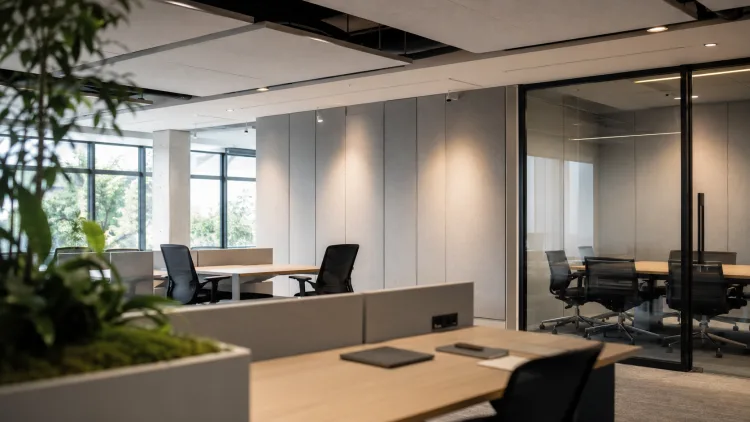
Glass meeting room beside an open office fitted with acoustic wall panels and ceiling clouds

SOUNDPROOFING VS SOUND ABSORPTION FOR YOUR OFFICE

Soundproofing and sound absorption are separate strategies for separate problems. Mixing them up is the single most common reason an office acoustics project disappoints.

Soundproofing stops sound from crossing from one space into another. It depends on mass, airtight sealing, and decoupling, and its yardstick is Sound Transmission Class (STC): a higher number means more sound stopped by the partition.

Sound absorption cuts echo and reverberation inside a single room. It uses soft, porous materials like acoustic panels and baffles, and it's rated by Noise Reduction Coefficient (NRC) on a scale from 0 to 1 — the closer to 1, the more sound the material soaks up instead of reflecting it.

On its own, absorption does little to keep sound from moving between rooms. Hang panels on a wall and that room gets less echoey — yet a conversation inside it can still be overheard next door. Stopping that takes blocking.

Most workplaces need both. Private offices and conference rooms call for blocking (STC) to stay private, while open-plan floors call for absorption (NRC) — and often sound masking — to keep the overall level down.

Stack of fabric-covered acoustic panel samples in assorted colors

OFFICE SOUNDPROOFING SERVICES WE PROVIDE

Our office soundproofing services handle blocking and absorption alike, chosen according to whether sound is escaping between rooms or building up inside one. Each service below is aimed at a particular kind of office noise.

Wall and Ceiling Soundproofing for Private Offices

Wall and ceiling soundproofing keeps sound from passing in or out of a private office. Our crews add mass, close gaps, and handle the plenum above shared ceilings; the STC goes up and conversations stay in the room — the starting point for office privacy.

Confidential Conference Rooms and Meetings

Keeping meetings confidential takes blocking plus background sound working together. Walls, door, and ceiling path get treated as a single system — a wall with a great STC rating still fails if speech can sneak over it through a shared drop ceiling. Learn more on our conference room soundproofing page.

Acoustic Treatment for Open-Plan Floors

In the open-plan layouts Silicon Beach companies love, absorptive panels, hanging baffles, and ceiling clouds tame echo and bring the general noise level down. High-NRC materials cut reverberation time, keeping voices from building into a roar.

Office Sound Masking Systems

Sound masking plays a soft, engineered background sound through ceiling speakers to shorten the distance speech can travel. Lifting the background level in a controlled way makes conversations harder to understand between desks and outside meeting rooms — more privacy, no extra volume.

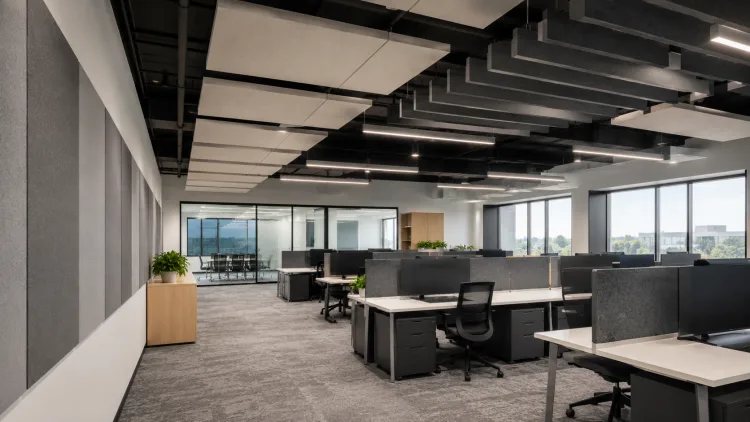
Open-plan office with suspended ceiling clouds and acoustic wall panels

WHY TEAMS CHOOSE OUR OFFICE SOUNDPROOFING COMPANY

Office soundproofing succeeds when someone correctly diagnoses whether a problem calls for blocking, absorption, or masking — and treats the flanking paths that sabotage most office acoustic work.

Licensed Installers, 20+ Years of Commercial Acoustic Work

Our licensed installers bring more than 20 years of commercial acoustic and soundproofing work to every job. Because that experience spans both blocking and absorption, each design follows sound-engineering principles instead of pushing one product line.

Blocking vs Absorption, Diagnosed Before We Build

Before we specify a single product, we work out which areas need blocking, which need absorption, and which need masking. That avoids the costly mistake of using absorptive panels on a transmission problem.

Acoustic Materials Made In-House

We fabricate acoustic materials in our own production shop and pick each product to suit the problem we measured. Owning production means we can dial in STC and NRC performance zone by zone instead of forcing one solution everywhere.

After-Hours Installs That Keep Business Moving

Installation is planned around how your office runs — evenings and weekends included — so work carries on as usual. Keeping downtime low is part of the project scope, not a footnote.

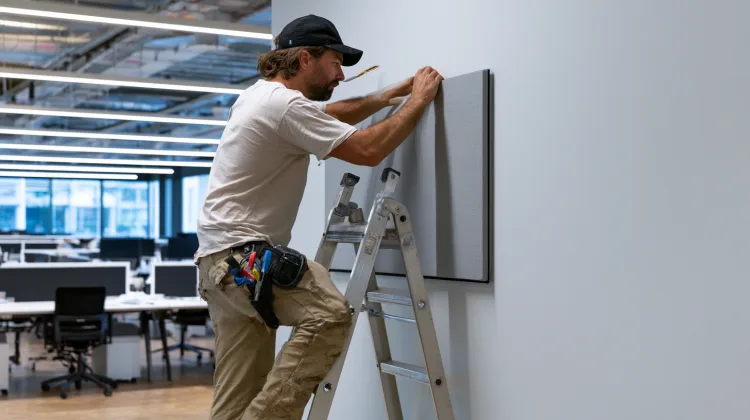
Installer attaching a fabric-wrapped acoustic panel to an office wall

HOW OUR OFFICE SOUNDPROOFING PROCESS WORKS

Every project runs through four stages, starting with measurement and ending with proof, so each area is treated for the acoustic problem it really has rather than one we assumed.

On-Site Assessment of Noise and Speech Privacy

We measure noise levels and check speech privacy in enclosed rooms and open areas alike. That tells us where sound is crossing between spaces and where it's reverberating inside one.

Design Built Around STC and NRC Targets

Rooms that need blocking get STC targets; rooms that need absorption get NRC targets. Setting measurable goals means every area is treated to a defined standard instead of a hunch.

Low-Downtime Installation

Blocking, absorptive, and masking systems go in on a schedule that keeps interruptions to a minimum. Sealing flanking paths, like open ceiling plenums and gaps, is built into the work.

Sound Measurement and Verification

Once the work is done, we repeat the noise and privacy readings and compare them against the baseline. That shows the real improvement on site, not a lab rating's promise.

Person working at a desk surrounded by acoustic privacy panels in an open office

WHAT NOISE REDUCTION YOU CAN EXPECT

Office soundproofing delivers measurable gains, but how much depends on the problem you're solving and whether flanking paths get treated — not on a product's soundproof label.

Between rooms, results hinge on STC and on sealing. A standard interior wall protects very little privacy; truly confidential speech typically calls for a heavier assembly — roughly STC 50 and up — along with sealed gaps and a solid ceiling path.

On an open floor, absorption is a function of NRC and of total treated area. Panels and baffles with high NRC ratings shorten reverberation and lower the general level, but they won't make a room silent or stop sound passing between rooms.

Flanking paths cap what you'll get in practice. Where offices share a drop ceiling over an open plenum, sound travels over the wall, so a high-STC partition underperforms until the ceiling path is dealt with.

Low-frequency noise is the toughest to tame. The rumble from rooftop HVAC units and mechanical rooms comes in long wavelengths, and those need heavier mass and decoupling than speech does.

Minimal office with one desk and an acoustically treated wall

BOOK YOUR OFFICE SOUNDPROOFING ASSESSMENT TODAY

Your office soundproofing project starts on site, with an assessment that separates transmission issues from reverberation issues and defines measurable STC and NRC goals. We then handle design, installation, and final verification for each area.

📞 Call Now to set up an assessment, or Request Your Free Quote and get an office soundproofing plan built for your team!

Frequently Asked Questions

Can you soundproof our office while we keep working?

Yes. We schedule the work for evenings and in phases to keep disruption low. Most blocking and absorption treatments go in with little downtime, so the business keeps running.

What does sound masking do, and does my office need it?

It's a low, carefully tuned background sound delivered from ceiling speakers, and it makes nearby conversations harder to follow. Open-plan floors and privacy-sensitive rooms benefit most, because masking shortens how far speech carries without adding volume.

How can we keep conference room discussions confidential?

Confidential meetings need a high-STC wall, a treated ceiling path, a sealed door, and enough background sound. A wall that looks solid won't protect privacy on its own if speech travels over it through a shared drop ceiling.

What's the best way to quiet an open-plan office?

Absorption and sound masking control open-plan noise far better than blocking does. Panels and baffles cut reverberation, while masking gently raises the background level so speech doesn't carry as far across the floor.

Will acoustic panels alone soundproof an office?

No. Acoustic panels soak up sound and reduce echo inside a room, but they don't stop sound from reaching the room next door. Stopping sound from crossing between spaces takes added mass, airtight sealing, and a treated ceiling path.

How does office soundproofing differ from sound absorption?

Soundproofing keeps sound from crossing between rooms and is rated by STC. Sound absorption cuts echo inside a room, rated by NRC. Blocking gives you privacy from one space to the next; absorption keeps noise from building up within a space. Most offices need both.

Santa Monica Soundproofing

Your Santa Monica & Greater LA Acoustics Team

We design sound environments around the people who use them, whether that means a recording studio, a music room, a home office, a boardroom set up for video meetings, a busy workplace, a restaurant, a club, a place of worship or a school auditorium.

View All Services

Request a consultation

Share a few details and our team will reach out

Let’s begin with the basics:

Prefer the phone? (877) 999-2201

Additional info (Optional)